In architecture, what gets built on site is never just the result of drawings. It is the result of coordination.
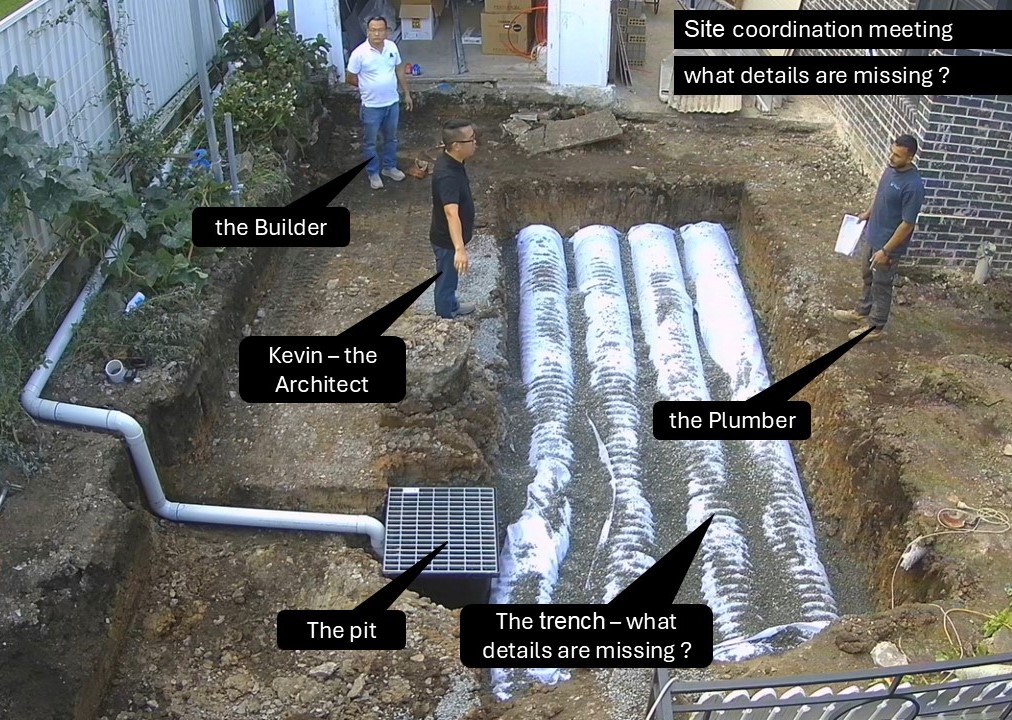
LVA Architects recently attended a site coordination meeting for an absorption trench installation within Georges River Council, one of the more stringent councils in Sydney when it comes to stormwater management and compliance.
This project is currently being designed and managed by LVA Architects, with our role extending beyond preparing documentation. Our focus is also to ensure that the approved design intent is properly understood, coordinated and constructed on site.
From Approved Drawings to Site Reality
On paper, an absorption trench system may appear relatively straightforward. However, once construction begins, successful execution depends heavily on how well the details are interpreted, coordinated and implemented by the project team.
During the site inspection, several key coordination matters were reviewed, including:
- Whether the trench depth and setout aligned with the approved drawings
- Whether the geotextile wrapping was installed correctly
- Whether inlet and outlet levels were coordinated with the stormwater pit and pipework
- Whether adequate allowance had been made for maintenance access and long-term performance
- Whether observation risers and cleaning eyes had been installed as required
These matters are not necessarily design problems. More often, they are coordination problems.
And this is where the role of the architect becomes critical. Because apparently drawings do not magically jump off the page and build themselves. Tragic, really.
The Architect’s Role During Construction
A well-prepared drawing package is important, but drawings alone are not enough. During construction, builders and trades often need clarification to ensure that what is being built matches the approved design, council requirements and long-term performance expectations.
By bringing the builder and plumber together on site, LVA Architects was able to:
- Identify missing or unclear details before they became construction issues
- Clarify the design intent against the approved documentation
- Coordinate the stormwater installation with the actual site condition
- Resolve issues early and avoid costly rework
- Help ensure the system performs as intended and complies with council requirements
This type of coordination is especially important for stormwater systems, where many components are concealed once construction is complete.
Avoiding Delays, Rework and Compliance Issues
For projects involving absorption trenches, particularly within strict council frameworks such as Georges River Council, delays and compliance issues often do not arise because the design is fundamentally wrong.
They arise because there is a gap between design and construction.
A trench that is installed too shallow, wrapped incorrectly, connected at the wrong level, or constructed without adequate maintenance access can create significant problems later. Once the trench is filled, covered and landscaped, fixing those issues becomes difficult, disruptive and expensive.
A timely site coordination meeting can prevent weeks of delay later.
Good Projects Are Coordinated Well
At LVA Architects, we believe good architectural service does not stop at design approval or documentation. A project needs to be properly managed through the construction process to ensure that design intent, technical requirements and site execution are aligned.
Because once an absorption trench is filled and covered, there is no easy way back.
Good projects are not just designed well.
They are coordinated well.
#Architecture #Stormwater #SiteCoordination #DAApproval #Construction #SydneyArchitect #LVAArchitects